
The Durability Score measures how much an athlete’s Fitness Signature (TP, HIE, PP) declines during long rides, reflecting resilience to prolonged fatigue. Expressed as a percentage, lower scores mean better durability. Accurate assessment requires rides over 2+ hours with maximal efforts late in the ride, and durability is distinct from overall fitness.
Definition
Durability Score measures how much your Fitness Signature declines during a long activity.
While your Fitness Signature (TP, HIE, and PP) is normally treated as stable during a ride, Durability modeling evaluates how those values change over time due to prolonged fatigue.
In simple terms:
Durability Score reflects how well your fitness “holds up” after hours of riding.
What It Represents
Durability describes a type of fatigue that:
- Builds gradually over long durations
- Does not meaningfully recover during the ride
- Requires full rest to restore
This long-duration fatigue is often associated with:
- Glycogen depletion
- Muscular fatigue
- Accumulated metabolic stress
An athlete with strong durability can still produce high power late in a ride or race.
Understanding the Score
Durability Score is expressed as a percentage decline in your Fitness Signature.
- 0% → No meaningful change in your signature during the ride
- 100% (theoretical) → HIE fully depleted and Threshold Power has decayed to Lower Threshold Power (LTP)
Lower scores indicate better durability. Typical durability ranges:
- ~15%+ → Less trained
- ~10% → Well-trained club athlete
- ~5% → Highly trained / elite
- <2% → Professional-level durability
Athletes with stronger durability can outperform riders with higher raw fitness but weaker late-race resilience.
How It Works
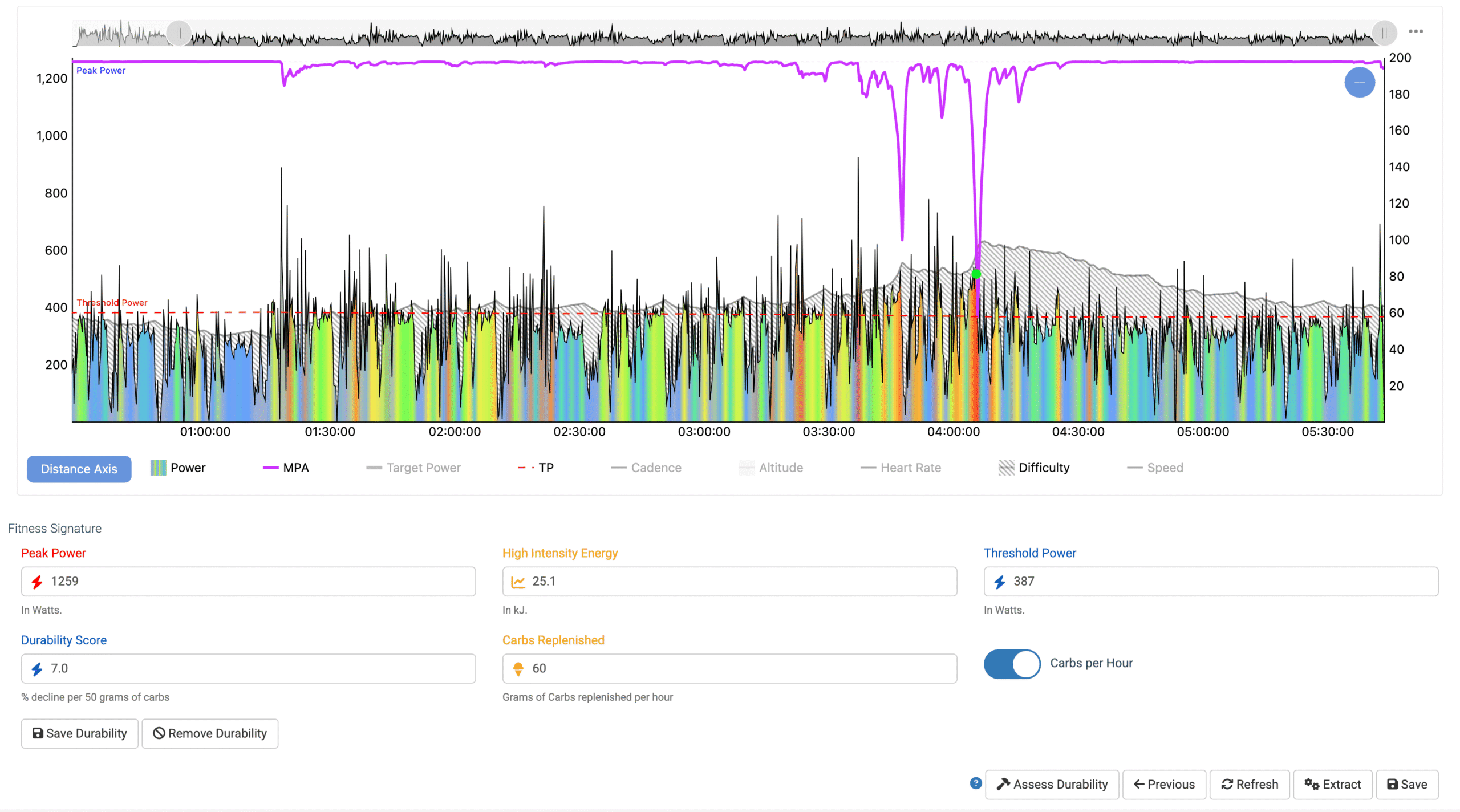
To assess durability:
- Select a ride longer than 2–3 hours
- Ensure you performed a maximal effort late in the ride
- Click Assess Durability
Xert then:
- Calculates a durability metric throughout the activity
- Models how TP and HIE decline over time
- Recalculates MPA using the adjusted signature
- Displays how your signature evolved during the ride
After assessing durability, you can mouse over the MPA chart to see how your signature changed over the course of your activity.
Getting a Valid Result
A pure endurance ride without a maximal effort will not produce meaningful durability results. For accurate durability assessment, use the following steps:
- Use rides longer than 2–3 hours
- Include a true maximal effort late in the activity
- Ensure your starting Fitness Signature was accurate
Note: If a Breakthrough occurred during the ride, durability assessment may not be valid.
Fueling Considerations
If using Carbs Used as your Durability Metric:
- You may input Carbs Replenished
- Reassess durability after entering fueling data
This allows you to evaluate how nutrition strategies impact late-ride performance.
Where You’ll See It
- At the bottom of the Activity Details page
- Via the Assess Durability button
- Reflected in updated MPA and signature charts
Common Misunderstandings
- Durability is not the same as fitness. You can have a high Fitness Signature but weak durability.
- Easy long rides do not assess durability. A maximal effort while fatigued is required.
Comments
0 comments
Please sign in to leave a comment.