
Maximum Power Available (MPA) is a dynamic measure of the highest power you can produce at any moment during exercise, fluctuating with fatigue and recovery. Used by Xert, MPA is bounded by your Peak Power and Threshold Power, powers key features like breakthrough detection, and reflects real-time changes during workouts and post-ride analysis.
Definition
Maximum Power Available (MPA) is the maximum power you are capable of producing at any given moment during exercise. It is a dynamic value that changes continuously as you fatigue and recover during exercise.
Your MPA is bounded by your Fitness Signature:
- Its highest possible value equals your Peak Power (PP).
- Its lowest possible value equals your Threshold Power (TP), not zero.
What It Represents
MPA models your remaining high-intensity capacity as the maximum power you can produce at any given moment, in real time. You can interactively view your MPA in real time using the Xert EBC app, custom data fields for Garmin ConnectIQ or Hammerhead extensions, or through post-ride activity analysis.
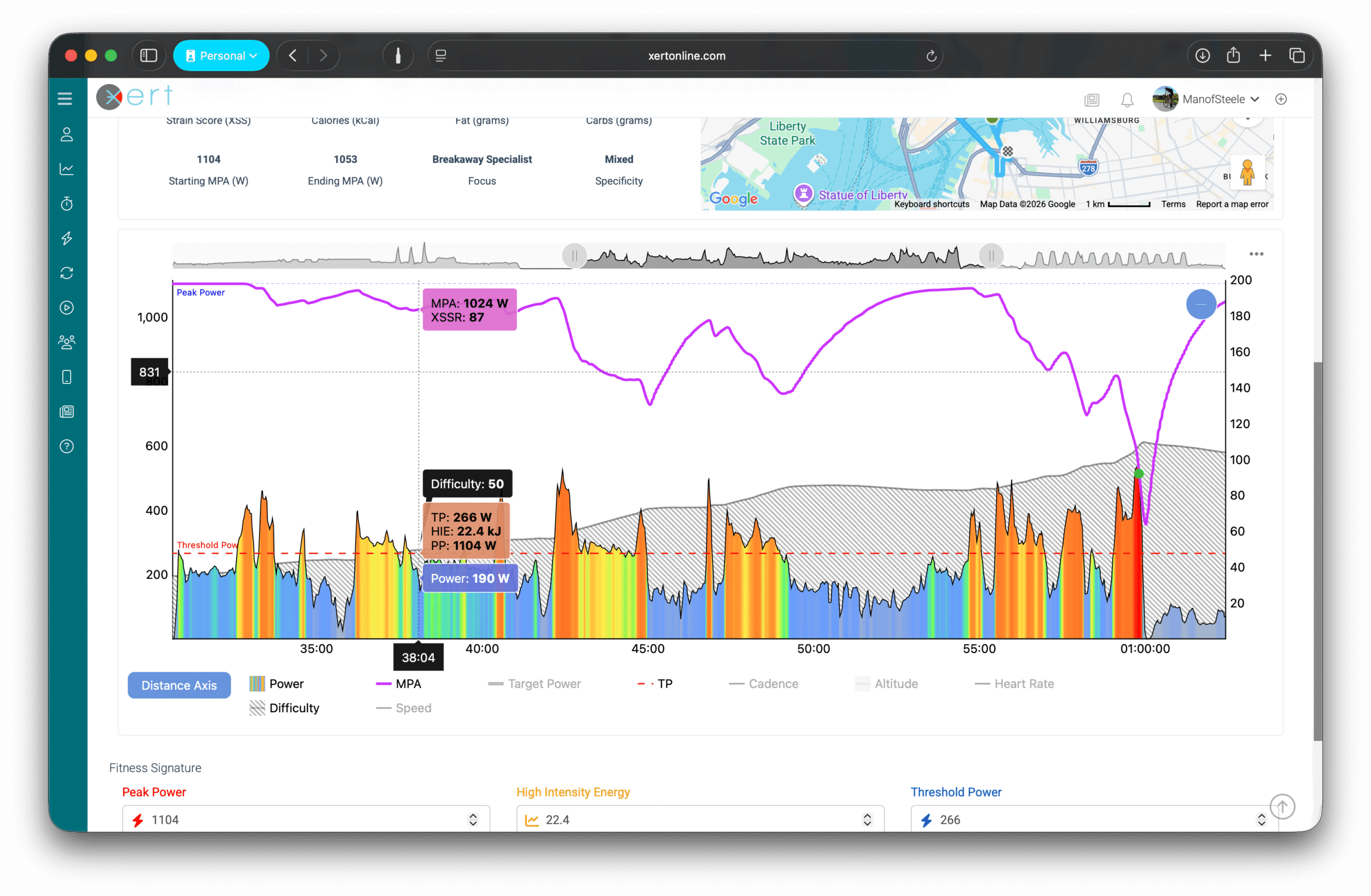
- When you ride above Threshold Power, your Maximum Power Available (MPA) decreases, reflecting accumulating fatigue. The harder you ride above Threshold Power or the longer you sustain a sustained effort above it, the faster MPA declines.
- When you ride below Threshold Power, MPA increases, reflecting recovery. The further below Threshold Power you ride, the faster MPA replenishes.
- The closer the MPA line comes to your actual power output, the harder the effort will feel.
- The moment your power equals your MPA represents a maximal effort, also referred to as a point-of-failure. At these points, you are unable to push any harder, as your Maximum Power Available limits your ability to produce power. When you push your limits, you will begin to appreciate that MPA is not just a number but an actual physiological phenomenon.
Because MPA responds dynamically to intensity changes, it captures both fatigue and recovery during stochastic, real-world efforts, making it well suited for capturing the strain of unstructured riding, such as group rides or races.
How Xert Uses It
MPA is a foundational element of the Xert system and powers many key features, including:
- Breakthrough detection
- XSS calculations
- Difficulty Score modeling
- SMART interval design & execution
- Time to Exhaustion (TTE)/Time to Recovery (TTR) calculations
- Xert Segment Hunter
Xert calculates MPA interactively using your power data and your Fitness Signature (TP, HIE, PP). When a maximal effort occurs, Xert evaluates whether your current Fitness Signature can explain the performance. If not, a Breakthrough is detected and your signature is automatically updated for you - no FTP testing required!
MPA is one of Xert’s core innovations and a primary reason athletes continue to train with the platform.
Where You’ll See It
You can view MPA in the post-ride analysis as a magenta line on your activity chart. On activity charts, maximal efforts are visualized when the MPA line dips and touches your power output, shown in the image below at the 1:00:00 mark:
Real-Time MPA can be seen using Xert ConnectIQ data fields & Xert extension for Hammerhead Karoo.
You can also preview your MPA for structured workouts & in real-time during workouts using the Xert EBC app and the Xert Remote Player or Xert Session Player.
Common Misunderstandings
- MPA is not static. It changes continuously throughout your ride as you fatigue and recover. Its starting value is equal to your Peak Power.
- MPA cannot not drop to zero. If you manage to pull MPA down all the way, it will become bounded by your Threshold Power.
- MPA’s maximum value remains equal to your Peak Power throughout a ride. Just as your FTP zones do not change hours into a long effort, the upper bound of MPA does not decline over time. However, later in a ride, MPA may decline more rapidly during hard efforts due to accumulated fatigue. Factors such as hydration, fueling, and durability influence how quickly MPA drops. You can evaluate your durability in post-ride analysis.
Related article: Durability Score
Comments
0 comments
Please sign in to leave a comment.